
Security Lens
Security perspective of your company.
- Who it is for: Chief Security Officers, CISOs and cybersecurity teams.
- The question it answers: What do we actually have, what is exposed, and what sits behind each entry point?
How you onboard the use case
Section titled “How you onboard the use case”You onboard the Security Lens by defining what the organization needs to know, recording each real instance as an Asset, ingesting what you already have, and normalizing it against the 7lens semantic model.
1. Define the attributes you need
Section titled “1. Define the attributes you need”First define what the organization needs to know about its applications, services and platforms. For applications, examples include application type, programming language, technology, business continuity requirements, RPO, RTO, entry points, web portals, APIs, AI agents, data consumed, data classification and associated code repositories. For services and platforms, define the attributes required to understand the security posture of the relevant technology, such as servers, containers, APIs, agents and other technology services.
2. Define the Assets
Section titled “2. Define the Assets”Every real instance you track becomes an Asset in Inventory: a server, a container, an API, a web portal, a code repository, a library, an AI agent, and more. Each Asset is recognized by its Asset Type and one Offering. Applications, Services and Platforms are not Assets: they are elements of the model that Assets belong to or map to.
3. Ingest the assets using Collector
Section titled “3. Ingest the assets using Collector”Use 7lens Collector to ingest information from the organization’s existing sources. The information may currently exist in Excel files, APIs, existing inventories, files, security systems and other enterprise sources. Customers frequently already have the information. The problem is that it is heavily distributed and difficult to interpret.
4. Normalize the information
Section titled “4. Normalize the information”7lens applies its semantic model to normalize the incoming information and establish relationships between the assets. This turns fragmented enterprise information into a security-oriented inventory that the CSO can actually understand and use.
5. Build a Lens
Section titled “5. Build a Lens”Once the 7lens Ontology is onboarded, configure the Lens on top of your existing Context: the attributes, relationships, mappings, and context this reading needs. You do not start from scratch, because the Ontology and the Context are already there. The seven named Lenses are reference use cases you configure, combine and extend, not separate pre-built products.
What 7lens connects
Section titled “What 7lens connects”The Security Lens brings these elements together and organizes them according to the organization’s semantic model and ontology, so their relationships become understandable: Applications, Services, Offerings and Platforms from the model, and the Assets in Inventory that evidence them, such as servers, containers, APIs, repositories and AI agents. Security context can then be attached throughout those relationships.
- Applications
- Services
- Service offerings
- Platforms
- Servers
- Containers
- APIs
- Web portals
- AI agents
- Code repositories
- Libraries
- Application data
- Data classifications
- Technology
- Ownership
- Security attributes
- Exposure points
- Security controls
Relationship chain: Internet → Web Portal → API → Application → Service → Infrastructure → Data
Security context can be attached throughout this relationship chain.
The problem
Section titled “The problem”Modern organizations face an increasingly sophisticated attack environment, including attacks involving highly orchestrated AI-agent systems. But one of the fundamental problems for security teams is much simpler. Enterprise inventories are often incomplete, fragmented and distributed across many systems. Security teams may have information about applications in one place, infrastructure somewhere else, APIs somewhere else, code repositories somewhere else, and security controls in yet another system. The organization may technically possess the data, but it does not have a unified semantic understanding of its technology estate.
You cannot protect what you don’t know you have.
The outcome
Section titled “The outcome”The CSO can answer the questions that matter: What applications do we actually have? Which are exposed? Which web portals are exposed to the Internet? Which APIs are exposed? How is each entry point protected? Is MFA used? Is there a WAF and how is it configured? Which application, service or data sit behind that entry point? Where are the vulnerabilities and what assets could be affected? The result is a far more complete, contextual understanding of the attack surface.
The value
Section titled “The value”The value is speed, completeness and context. 7lens rapidly ingests distributed enterprise information, normalizes it, and organizes it to the semantics security teams need. The customer does not have to manually build a perfect inventory first.
Example
Section titled “Example”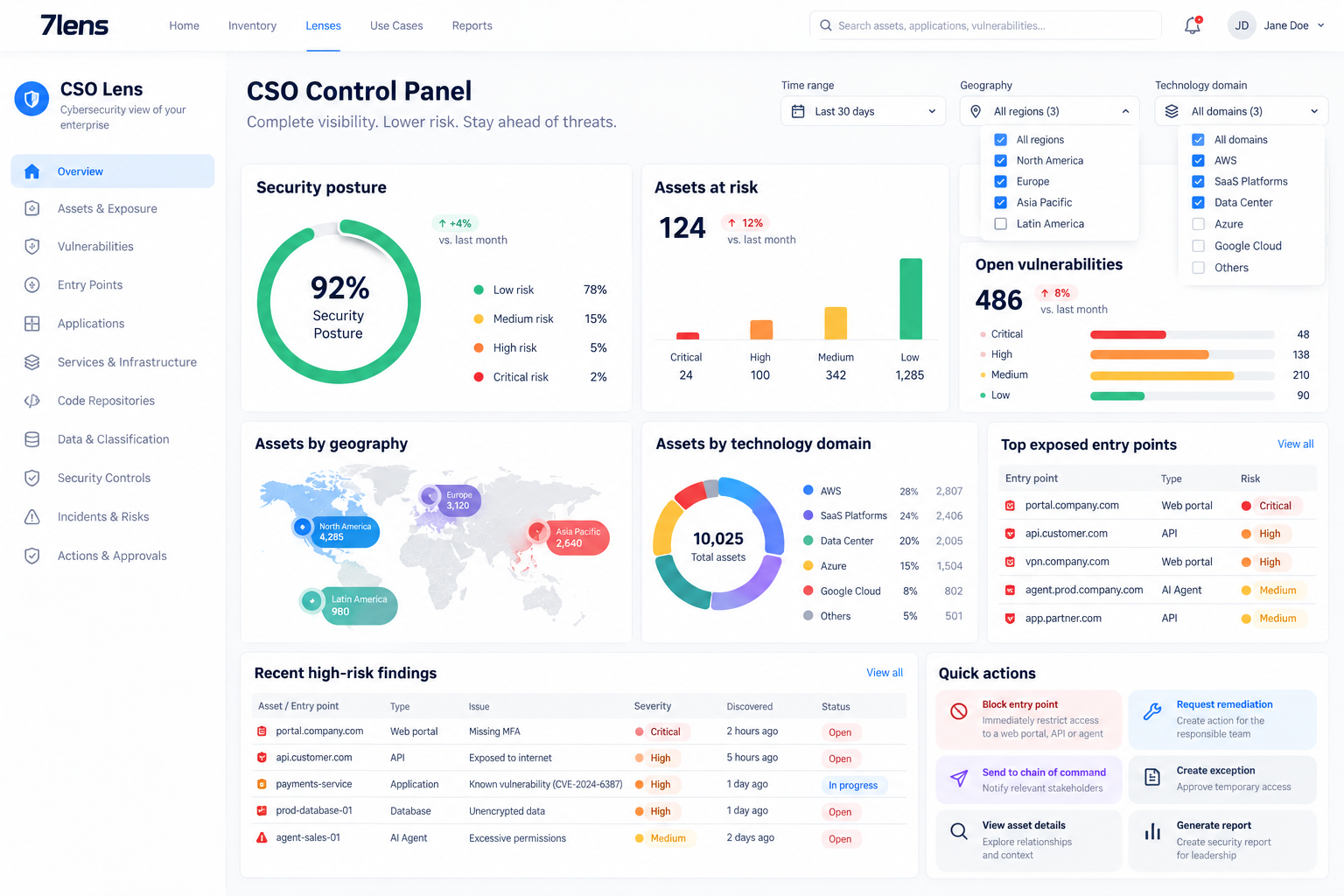
An example of what you can build within this use case.
Next steps
Section titled “Next steps”- Onboarding in under 40 hours: configure the Context every lens reads.
- Data model: the Ontology behind each lens.