
Lock-In Free Lens
Own your enterprise semantics. Integrate with any tool. Avoid vendor lock-in.
- Who it is for: Enterprise architecture, technology leadership, CTO, CFO, CISO, and anyone responsible for consistency across multiple technology-management platforms.
- The question it answers: How do we own our enterprise semantics and integrate any tool without redefining the enterprise inside each one?
How you onboard the use case
Section titled “How you onboard the use case”You onboard the Lock-In Free Lens by selecting the frameworks you use, defining your own canonical ontology, and mapping that ontology to each external system.
1. Select the frameworks and models you use
Section titled “1. Select the frameworks and models you use”Choose the data models, regulatory, compliance and industry frameworks, technology platforms and external tools you work with. Examples include DORA, ISO, NIS2, ServiceNow CMDB, IBM Apptio, TBM, FOCUS and other organizational or technology models. 7lens maintains mappings between its concepts and these external frameworks and models.
2. Define your core ontology
Section titled “2. Define your core ontology”Define your canonical semantics inside 7lens, the enterprise dictionary the organization owns rather than letting each vendor define independently.
3. Configure mappings
Section titled “3. Configure mappings”Configure how 7lens ontology concepts map to external-system concepts, from a 7lens concept to an external framework or tool concept. Mappings can include tags and other relationships.
4. Define Groups
Section titled “4. Define Groups”Groups are a core organizational mechanism. A group can be defined by the organization, a framework, an external tool, a data model or a strategic purpose. Groups let concepts be organized and mapped consistently across external systems.
5. Integrate
Section titled “5. Integrate”Provide the required information to external platforms via API, Events or Excel export. The receiving tool imports the information programmatically or manually.
6. Build a Lens
Section titled “6. Build a Lens”Once the 7lens Ontology is onboarded, configure the Lens on top of your existing Context: the attributes, relationships, mappings, and context this reading needs. You do not start from scratch, because the Ontology and the Context are already there. The seven named Lenses are reference use cases you configure, combine and extend, not separate pre-built products.
What 7lens connects
Section titled “What 7lens connects”7lens becomes the organization’s core semantic layer. The customer defines its own canonical concepts in 7lens, this is how our organization defines an application, a service or a business domain, and external tools and frameworks are mapped to those concepts. The customer need not change its enterprise language each time it adopts a tool.
- Technologies
- Applications
- Organizations
- Geographies
- Companies
- Business domains
- Services
- Groups
Relationship chain: Enterprise ontology → ServiceNow → FinOps → TBM → FOCUS → DORA → Other mappings
The enterprise ontology branches into each external framework or tool through a mapping. Swap ServiceNow for another CMDB, or one FinOps platform for another, and only the mapping changes. The core enterprise definition does not.
The problem
Section titled “The problem”Different vendors impose different terminology and data models. The CFO’s FinOps platform, the CTO’s ServiceNow, security’s platform or CMDB, different business-service platforms and regulatory frameworks each come with their own vocabulary. Each platform makes the organization redefine Technologies, Applications, Organizations, Geographies, Companies, Business domains, Services and other concepts. Over time enterprise semantics fragment across vendors, creating dependency and painful migrations.
The outcome
Section titled “The outcome”The external system sees the structure and terminology it requires, while the enterprise retains ownership of its underlying semantic model. If the organization later swaps ServiceNow for another CMDB, or one FinOps platform for another, it does not redefine its ontology. Only the mapping changes; the core enterprise definition stays the same.
The value
Section titled “The value”Own your ontology. Own your semantics. Integrate with any tool. Change vendors without redefining your enterprise. This is the vendor-lock-in-avoidance use case.
Example
Section titled “Example”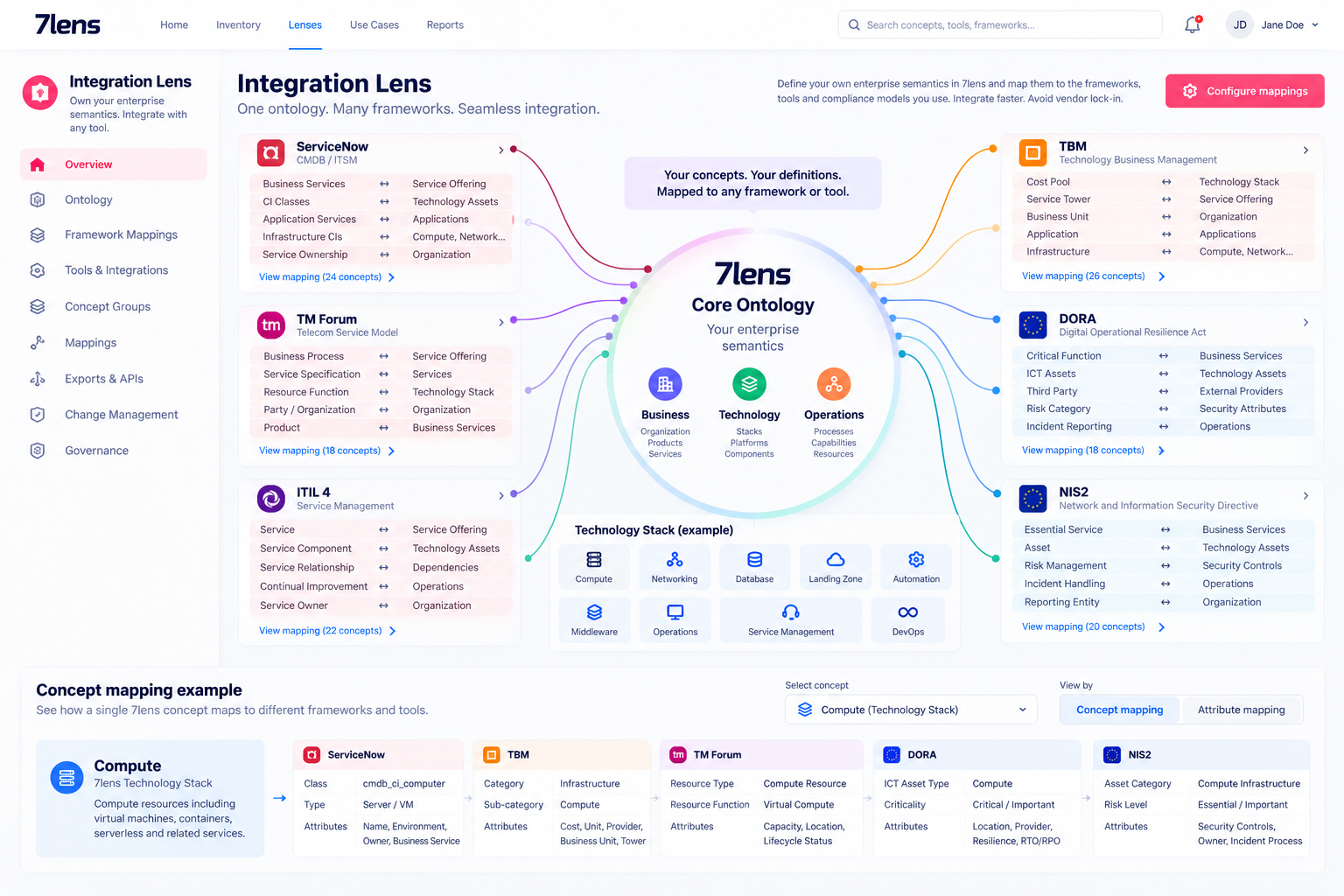
An example of what you can build within this use case.
Next steps
Section titled “Next steps”- Onboarding in under 40 hours: configure the Context every lens reads.
- Data model: the Ontology behind each lens.